
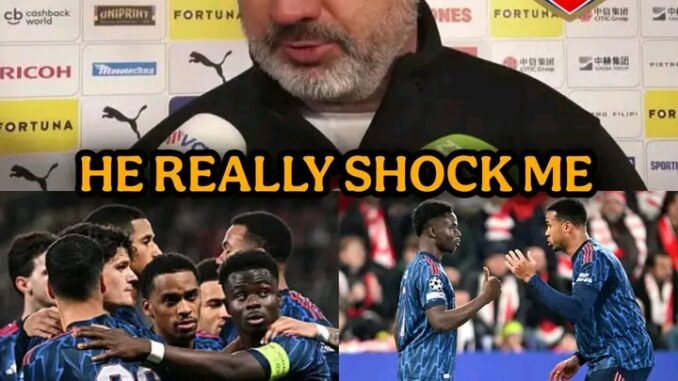
It was a tense night at the Emirates Stadium, the kind of night that reminds you why football can feel like theatre — raw, emotional, and unpredictable. Arsenal came out with fire, dismantling Slavia Prague in a 3-0 victory that left their visitors stunned. But beyond the scoreline, what caught everyone’s attention was one Arsenal player whose performance demanded respect — and surprisingly, it wasn’t Bukayo Saka this time.
After the match, Slavia Prague’s coach, Jindřich Trpišovský, didn’t mince words. “I’ve coached for many years,” he said, his tone carrying both exhaustion and admiration, “but I’ve never seen such a dangerously aggressive player in my life.” Though Saka’s name was on everyone’s lips, Trpišovský’s praise was directed elsewhere — to another Arsenal star who left his mark on the pitch with a kind of controlled fury.
The game itself was electric. Arsenal’s movement was sharp, their rhythm relentless, and their energy unmatched. While Saka played his usual elegant, tactical game, this other Arsenal player embodied something more primal — pure aggression paired with skill. Every tackle, every sprint, every duel screamed hunger. He didn’t just play football; he imposed it.
Trpišovský, still reeling from the loss, couldn’t help but admire what he witnessed. “That player,” he said, pausing as if searching for the right words, “played like he had something to prove. His intensity, his willingness to fight for every ball, it was… unsettling, in the best possible way.” For a visiting coach to admit that level of awe is rare — especially after a defeat.
Fans in the stadium noticed it too. While the crowd roared for goals, they also rose to their feet for tackles, interceptions, and the relentless pressing that kept Slavia Prague pinned back. This Arsenal player became the embodiment of Arteta’s new era — technical brilliance fused with grit and defiance.
In a sport that often glorifies finesse, Trpišovský’s comments were a reminder that aggression, when properly channeled, is a form of artistry too. “He was everywhere,” the coach added, “pressing, blocking, winning balls he had no right to win. Players like that are rare — they change the mood of a team.” His respect, though begrudging, was genuine.
The Slavia Prague manager made it clear that his admiration wasn’t born out of defeat alone. He saw in that Arsenal player a reflection of what makes champions — a refusal to yield, a fire that doesn’t dim with the scoreline. “If every young player had that attitude,” he said with a sigh, “football would be a far tougher game to play.”
As the dust settles on that match, the story isn’t just about Arsenal’s win or Saka’s brilliance. It’s about the rise of another warrior in red and white — one whose intensity burned so bright it left even the opposing coach speechless. Sometimes, the loudest praise comes not from fans, but from the very rivals who couldn’t stop you.
Leave a Reply