
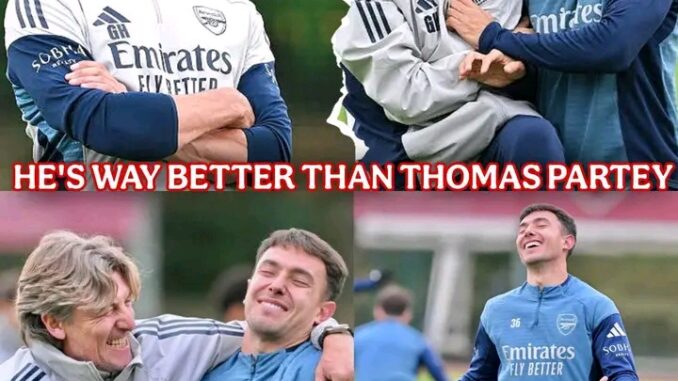
Arsenal’s defensive coach, Gabriel Heinze, has stirred the football world with a blunt remark that has sent waves through the Gunners’ fanbase. According to him, new signing Martin Zubimendi possesses qualities that make him a better player than Thomas Partey — two crucial attributes that Partey, in Heinze’s view, simply lacks. This statement has sparked intense debate, especially among those who still see Partey as one of Arsenal’s most reliable midfield generals.
Heinze, known for his sharp tactical insight and no-nonsense evaluations, recently praised Zubimendi’s style and influence on the team. The 24-year-old Spaniard, who joined Arsenal from Real Sociedad, has already impressed the coaching staff with his football IQ, calmness on the ball, and ability to dictate tempo. Heinze spoke passionately about Zubimendi’s arrival, describing him as a player who brings a refreshing balance of technique and tactical awareness.
“Zubimendi plays with vision and control,” Heinze explained. “He reads the game beautifully and knows when to break play or start a move. His passing range, awareness, and decision-making are on another level — things that make a real difference in a high-intensity league like the Premier League.” The coach’s praise painted a picture of a player built not just for the present, but for Arsenal’s long-term vision of dominance.
The comparison, though flattering for Zubimendi, has not sat well with every Arsenal supporter. Many remember how Partey, since joining from Atlético Madrid in 2020, helped transform Arsenal’s midfield with his strength, composure, and leadership. Partey has been one of the few players capable of shielding the defense while also initiating quick transitions — a rare balance in modern football. To some, Heinze’s comments feel dismissive of a proven warrior who has bled Arsenal red for seasons.
Nevertheless, Heinze’s claim may reflect the club’s evolving tactical philosophy rather than personal criticism. Arsenal has increasingly emphasized mobility, technical sharpness, and adaptability over sheer physical dominance. In that sense, Zubimendi embodies the next phase of the Gunners’ project — a new-generation midfielder who can control games from deep and move fluidly in positional rotations.
Zubimendi’s success at Real Sociedad offers further evidence of his maturity. In La Liga, he was known for anchoring the midfield with quiet authority, winning duels without recklessness and building attacks from deep. His calmness under pressure and ability to read the rhythm of the match have made him a sought-after talent across Europe, and Arsenal’s capture of him was seen as a strategic masterstroke.
Meanwhile, Partey’s challenges — from injuries to occasional inconsistency — may have influenced Heinze’s perspective. At 32, Partey is entering the later years of his prime, while Zubimendi represents renewal and longevity. For a team aiming to stay competitive for the next decade, Heinze’s support for the Spaniard might signal Arsenal’s desire to phase in a new midfield structure centered on youth, intelligence, and adaptability.
Still, whether Zubimendi can truly outshine Partey remains to be seen. Heinze’s bold words have set a high bar, but they also reflect the hunger within Arsenal’s camp to evolve and surpass their past limitations. If Zubimendi can match his coach’s faith with consistent performances, he may well become the cornerstone of Arsenal’s next era — and the player Partey once was for the club.
Leave a Reply