
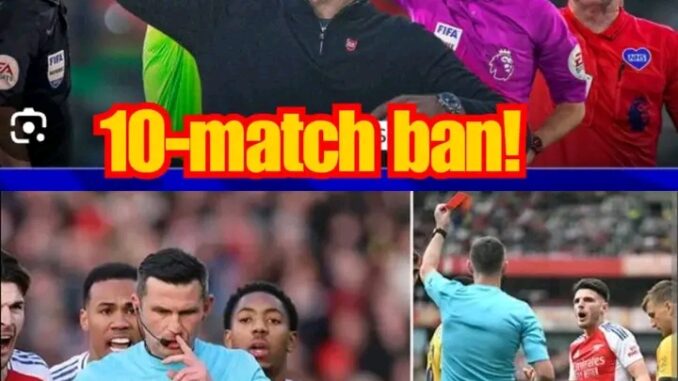
UEFA has officially released a statement confirming a 10-match suspension for Arsenal’s midfielder Martin Zubimendi following comments he made on Instagram criticizing referee Davide Massa after the clash with Atlético Madrid. The decision has sparked intense debate across the football community, as many fans believe the punishment is excessive for what they consider a moment of emotional reaction rather than malice. The governing body stated that the suspension reflects a breach of conduct and disrespect toward match officials, emphasizing that players are expected to uphold professionalism both on and off the field.
Zubimendi’s troubles began during Arsenal’s 4–0 victory over Atlético Madrid, where he received a yellow card in the 38th minute after a light challenge on Nicolás González. The referee’s decision was met with widespread disbelief, with many describing it as harsh and unnecessary. Both Zubimendi and manager Mikel Arteta were visibly frustrated on the sidelines, a reaction that foreshadowed the tension that followed online after the match.
The midfielder took to Instagram shortly after the game, where he expressed his displeasure at the referee’s call, implying bias and inconsistency in officiating. That post, though quickly deleted, had already gone viral, catching UEFA’s attention. Within hours, an investigation was launched into Zubimendi’s conduct under the federation’s disciplinary framework concerning public criticism of officials.
The one-match suspension initially expected due to accumulated yellow cards was soon overshadowed by the disciplinary extension. UEFA determined that his social media post represented “an attack on the integrity of officiating,” and thus extended the sanction to 10 matches. The ruling effectively sidelines the Spanish midfielder for most of the remaining Champions League group stage and possibly part of the knockout rounds, depending on Arsenal’s progression.
Supporters and pundits have rallied behind Zubimendi, calling UEFA’s punishment “disproportionate” and “petty.” Many argue that emotional responses are part of the game, especially in moments of controversy. Social media platforms have been flooded with messages of support for the player, urging UEFA to reconsider what many deem an overreach of authority in policing personal expression.
In contrast, some analysts believe UEFA is setting a clear precedent to discourage players from publicly questioning referees, especially in the era of viral media. They argue that maintaining respect for officials is critical for preserving football’s image and that leniency in such cases could lead to chaos. Regardless, the decision has reignited the broader conversation about freedom of speech versus professional responsibility in modern sports.
Meanwhile, Arsenal faces the immediate challenge of replacing their midfield anchor for several key fixtures. Zubimendi’s absence could open the door for Christian Nørgaard or young talent Myles Lewis-Skelly to step into the role against Slavia Prague on November 4. Arteta, who has been praised for his rotation policy, may need to rethink his midfield structure as the club navigates a congested schedule.
Despite the controversy, Zubimendi remains a crucial part of Arsenal’s project. His composure, control, and tactical intelligence have been central to their impressive start this season. While sidelined, he will be expected to stay involved in training and team preparations. For now, Arsenal fans can only hope that cooler heads prevail and that UEFA reconsiders a ban that, to many, feels like punishment far beyond the crime.
Leave a Reply